Guide · emergency lighting
The lights nobody notices until the power goes.
Emergency lighting installation, testing and repair for business premises across Solihull — and a plain account of what BS 5266, the British Standard for emergency lighting, expects you to be doing with it once it is on the wall.
What you're expected to do
Two tests and a log book.
That really is the whole duty cycle. The monthly test can be done by a competent person on site; the annual full-duration test and any remedial work is where an electrician comes in.
01
Monthly function test
Each luminaire and exit sign is switched into emergency mode for a short period and checked that it illuminates, then that it recharges. It takes minutes on a small premises, and it is the test that catches a dead battery before it matters.
02
Annual full-duration test
Once a year the system runs for its rated duration — usually three hours — and every fitting must still be lit at the end of it. Anything that dims out early has failed and needs the battery or the fitting replacing.
03
The log book
Both tests, plus any repairs, get recorded and kept on site. When a fire officer, insurer or incoming tenant asks, the log book is the evidence. No log book, in practice, means no testing as far as anyone else is concerned.
What gets installed
Four things, sited where they're needed.
A design starts with the escape routes and the risks, not with a catalogue. Where fittings are needed gets worked out from your layout — then you get a quotation with the positions on it.
- Escape route lighting
- Lighting along the routes people would actually use to leave — corridors, stairs, changes of level and direction, and the final exit door.
- Open area lighting
- Anti-panic lighting in larger open spaces, so people can see well enough to find an escape route rather than freezing where they stand.
- Exit signage
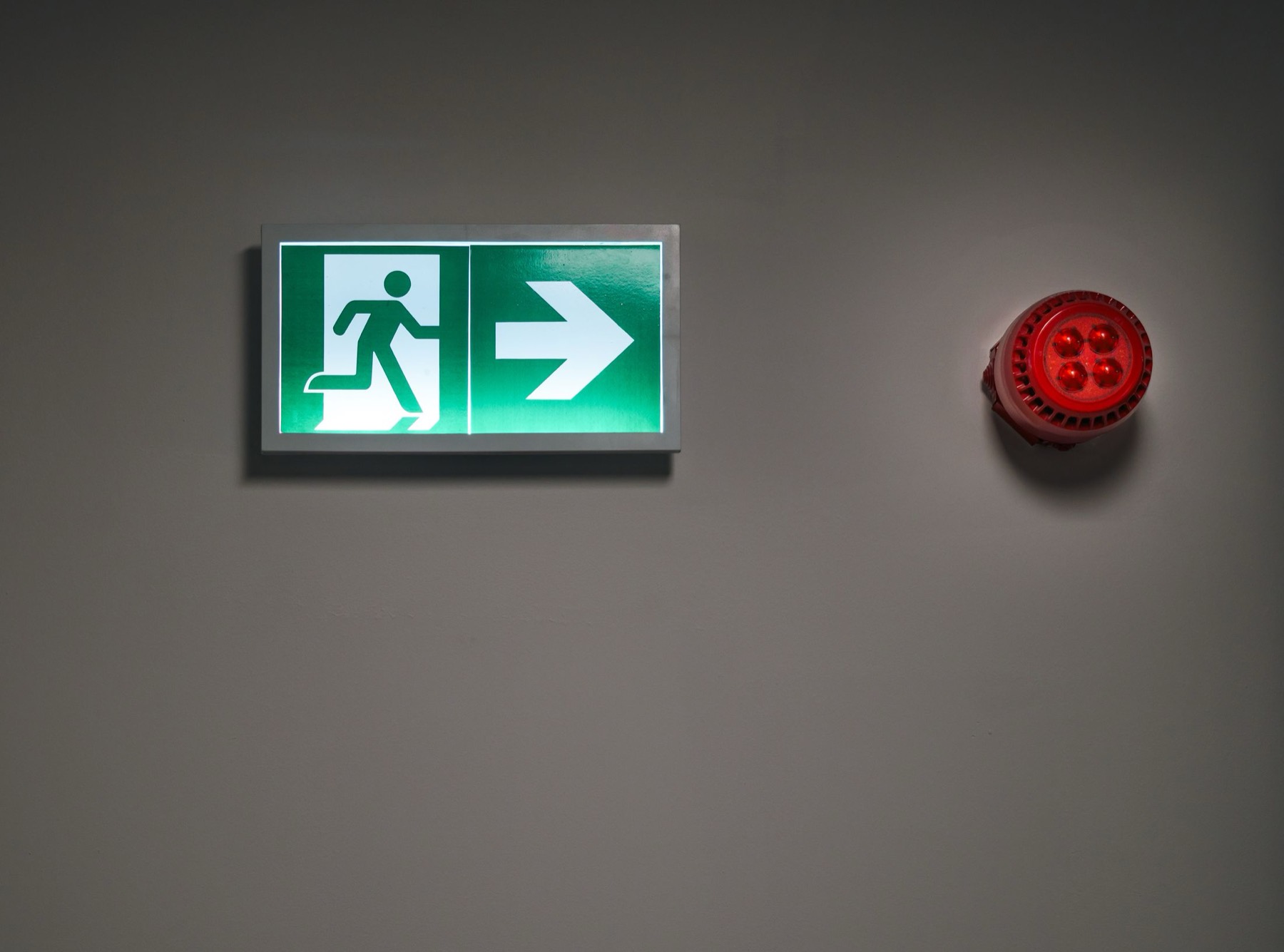
- Maintained or non-maintained exit signs with the running-man pictogram, sited so that one sign is visible from wherever the last one stopped being readable.
- High-risk task areas
- Lighting over anything that has to be shut down safely before people leave — machinery, plant, a kitchen range.
When a test fails
Repairs, not a replacement scheme.
Most annual test failures are batteries, not fittings. A battery pack is a fraction of the cost of a new luminaire, and swapping one is a ten-minute job — so that is what gets quoted first, and a full replacement only where the fitting itself has genuinely had its day.
Where an existing system has been extended piecemeal over the years and nobody can say what is on which circuit, it is usually worth an afternoon establishing that properly before spending money on parts.
Book a test or a survey
07944 020814Or the office on 0121 745 2556
info@adandcelectrical.co.ukMonday – Friday8.00am – 7.00pm
Saturday & Sunday8.00am – 6.00pm
Weekend visits are normal here, which for a shop or a unit usually means the test happens on a day you are shut rather than a day you are trading.